
Brass: Lancashire
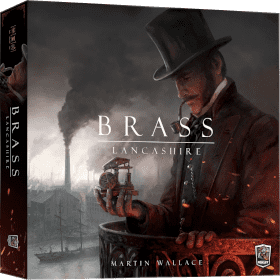 Brass: Lancashire — pierwotnie wydane jako Brass — to ekonomiczna gra strategiczna opowiadająca historię konkurujących ze sobą przedsiębiorców bawełnianych w Lancashire w okresie rewolucji przemysłowej. Musisz rozwijać, budować i budować swoje gałęzie przemysłu oraz sieci, aby móc wykorzystać popyt na żelazo, węgiel i bawełnę. Gra toczy się w dwóch fazach: fazie kanałów i fazie kolei. Aby wygrać, zdobądź najwięcej punktów zwycięstwa (PZ), które są liczone na koniec każdej fazy. PZ są przyznawane za kanały, linie kolejowe i istniejące (odwrócone) kafelki przemysłu. W każdej rundzie gracze wykonują tury zgodnie z torem kolejności tur, otrzymując dwie akcje do wykonania jednej z następujących czynności: zbudowanie kafelka przemysłu, zbudowanie linii kolejowej lub kanału, rozwinięcie przemysłu, sprzedaż bawełny, zaciągnięcie pożyczki.
Na koniec swojej tury zastępujesz dwie zagrane karty dwiema kolejnymi z talii. Kolejność tury jest ustalana na podstawie kwoty wydanej przez gracza w poprzedniej turze, przy czym gracz z najniższą kwotą zaczyna. Ten mechanizm kolejności tury otwiera pewne strategiczne opcje dla graczy grających później, umożliwiając rozgrywanie kolejnych tur.
Po pierwszym zagraniu wszystkich kart (z uwzględnieniem rozmiaru talii dostosowanego do liczby graczy) faza kanałów kończy się i rozpoczyna się runda punktowania. Po podliczeniu punktów wszystkie kanały i wszystkie przedsiębiorstwa najniższego poziomu są usuwane z gry, po czym rozdawane są nowe karty i rozpoczyna się faza kolejowa. W tej fazie gracze mogą zajmować więcej niż jedną lokację w mieście, a budowa z podwójnym połączeniem (choć kosztowna) jest możliwa. Pod koniec fazy kolejowej rozpoczyna się kolejna runda punktowania, a następnie wyłaniany jest zwycięzca.
Karty ograniczają możliwości budowania przemysłu, sprzedaży bawełny lub budowania połączeń (choć każda karta może być użyta do „rozwoju”). Prowadzi to do strategicznego planowania i przechowywania kart. Zasoby są powszechne, więc jeśli budujesz linię kolejową (która wymaga węgla), musisz wykorzystać węgiel z najbliższego źródła, którym może być kopalnia węgla przeciwnika, co z kolei przybliża ją do zdobycia punktów (tj. jej wykorzystania).
Liczba graczy: 2 - 4
Czas gry: 68 mn
Złożoność: 3 / 5
Zagraj w Brass: Lancashire i 1421 inne gry online.
Bez ściągania, bezpośrednio z twojej przeglądarki.
Ze swoimi przyjaciółmi i tysiącami graczy z całego świata.
Darmowe.


Zagraj w Brass: Lancashire i 1421 inne gry online.
Bez ściągania, bezpośrednio z twojej przeglądarki.
Ze swoimi przyjaciółmi i tysiącami graczy z całego świata.
Darmowe.
Streszczenie zasad
Core Turn Structure On your turn, you must perform exactly 2 actions (Exception: Everyone only takes 1 action during the very first round of the game). For every action you take, you must discard exactly 1 card from your hand. Turn order for the next round is determined by how much money you spend in the current round. The player who spends the least goes first; the player who spends the most goes last.
The 5 Actions You may perform any combination of the following actions, including taking the same action twice:
1. Build: Place an industry tile on the board.
Location Card: Build any industry in the matching city (does not need to be connected to your network).
Industry Card: Build the matching industry in any city that is part of your established network.
Cost: You must pay the money on the tile, plus any required Coal or Iron.
2. Network: Expand your connections.
Canal Era: Place 1 canal for £3.
Rail Era: Place 1 rail for £5 + 1 Coal, OR place 2 rails for £15 + 2 Coal.
Rule: New links must connect to a location already in your network.
3. Develop: Discard 1 or 2 of the lowest-level industry tiles from your player board to access higher-level, more profitable tiles.
Cost: 1 Iron per tile removed.
4. Sell: Flip your un-flipped Cotton Mills to increase your income and prepare them for scoring.
Must be connected to an un-flipped Port (yours or an opponent's) OR connected to the Distant Market.
You can sell from multiple mills in a single action.
5. Loan: Take an immediate cash injection of £10, £20, or £30 from the bank.
Penalty: Your income track drops by 1, 2, or 3 color-band levels.
Restriction: You cannot take loans during the final 4 rounds of the Rail Era.
The Golden Rule of Resources - Understanding how resources move is the key to winning Brass:
1. Coal needs a path: To use Coal, your build site must be physically connected (via any player's canals/rails) to an unexhausted Coal Mine or a Port with a trade icon. You must always consume the closest available coal.
2. Iron teleports: Iron does not require network connections. You can use Iron from any unexhausted Iron Works on the board, regardless of where it is.
3. If no resources are on the board, you may buy them from the global market, provided you have the required network connection for Coal (Iron can always be bought from the market).
Era Transition & Scoring - Scoring occurs at the end of both the Canal Era and the Rail Era.
Network Links: Score 1 VP for every gold link symbol on the two location tiles connected to your canal/rail.
Flipped Industries: Score the VP value printed on all of your flipped industry tiles.
Between Eras:
1. All Level 1 industry tiles are permanently removed from the board.
2. All Canal links are removed.
3. Level 2+ industries remain on the board and will score again at the end of the Rail Era.
BGA-Specific Tips for Playing
Undo is your friend: Brass is a highly calculable game. Use the "Undo" button on BGA to test a sequence of actions (especially double-rail placements or double-develops) to ensure you have exactly enough money and resources before committing.