
Niepożądani goście
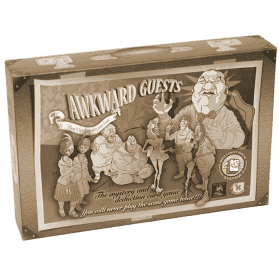 Niepożądani Goście to jedyna w swoim rodzaju gra dedukcyjna, z nieskończoną liczbą konfiguracji. Możesz dowolnie zmieniać okoliczności morderstwa Woodruffa Waltona i nigdy nie zagrać dwóch takich samych gier! (Walton na pewno ci za to nie podziękuje).
Do rozwiązania każdej sprawy gra wymaga od ciebie wykorzystania prawdziwych zdolności detektywistycznych. Aby rozwikłać zagadkę, musisz przesłuchać podejrzanych, przesłuchać służbę domową, zbadać miejsce zbrodni, szukać wskazówek w rezydencji Waltonów i zapoznać się z raportami policyjnymi. Będziesz to robić, wymieniając się informacjami z przeciwnikami lub ukrywając je przed nimi, więc przygotuj się na wykorzystanie wszystkich swoich umiejętności detektywistycznych!
KTO zabił pana Waltona?
JAK morderca zakończył jego życie?
DLACZEGO morderca go zabił?
Czy był WSPÓLNIK?
Istota gry Niepożądani Goście jest prosta: gracze mają do dyspozycji sześć kart, a każda karta ma wartość 1, 2 lub 3 punkty, w zależności od ilości informacji, jakie zawiera, oraz kilka elementów dochodzenia (tj. tematów informacji na karcie). Podczas tury, prosisz o informacje na temat dwóch różnych elementów dochodzenia, którymi jesteś zainteresowany. Pozostali gracze mogą zaoferować ci karty zawierające żądane elementy dochodzenia, a ty możesz wymienić się na te karty, dając graczom oferującym taką samą liczbę punktów, jaką zaoferowali za pomocą kart z twojej ręki.
Po zakończeniu każdej rundy, gracze mogą spróbować rozwiązać zagadkę. Jeśli zagadka nie zostanie rozwiązana, gracze odrzucają część kart z ręki i otrzymują trzy nowe karty. Wygrywa gracz lub gracze, którzy jako pierwsi rozwiążą zagadkę.
Liczba graczy: 1 - 8
Czas gry: 18 mn
Złożoność: 2 / 5
Zagraj w Niepożądani goście i 1378 inne gry online.
Bez ściągania, bezpośrednio z twojej przeglądarki.
Ze swoimi przyjaciółmi i tysiącami graczy z całego świata.
Darmowe.


Zagraj w Niepożądani goście i 1378 inne gry online.
Bez ściągania, bezpośrednio z twojej przeglądarki.
Ze swoimi przyjaciółmi i tysiącami graczy z całego świata.
Darmowe.
Streszczenie zasad
Awkward Guests: The Walton Case
This is a deduction and information-trading game. All players try to solve the murder on Mr. Walton. The first player to do so correctly, wins the game.
Each player has their own investigation sheet (private to them) to keep track of the information they learn during the game.
Goal
Be the first player to correctly solve the case by identifying:
- - WHO killed Mr. Walton?
- - WHY did they kill him (motive)?
- - HOW did they put an end to his life (weapon)?
- - Was there an ACCOMPLICE and, if so, WHO and WHY?
(For Beginner / Very Easy / Easy cases there is never an accomplice.)
Information in the game
Each card has:
- - an information value (1–3), representing the amount of valuable information, and used to price exchanges;
- - references (suspects and/or rooms) showing what the info is about;
- - the case-related information;
- - how the information can be denoted on the tracking sheet.
Round structure
The game is played in rounds. In each round, every player takes one turn (anti-clockwise). Each turn has 3 phases:
- - Inquiry Phase
- - Offer Phase
- - Exchange Phase
After all players have taken a turn, the round ends with a Solution Phase. If no one has solved the murder in this phase, the game continues with the Discard Phase.
Your turn
1. Inquiry Phase (ask for 2 references)
On your turn, you must request information about exactly 2 different references:
- - suspects (the 6 guests), and/or
- - rooms in the mansion.
So you may ask for: 2 suspects, 2 rooms, or 1 suspect and 1 room. Arrows are used to show all players which 2 references have been chosen.
2. Offer Phase (others offer relevant cards)
Starting with the player to your right and continuing anti-clockwise, each other player may prepare an offer:
- - They may offer any number of cards from their hand, or choose not to offer any cards at all;
- - Every offered card must contain at least one of the references you requested.
- - The offered cards are placed face down and a marker with the offer value (the sum of information values in the offer (1–3 per card)) is placed on top of it.
Offers are final once declared.
3. Exchange Phase (you choose and pay)
After all offers are made, you choose whether to exchange and with whom:
- - You may exchange with as many players as you want this turn;
- - For each chosen offer, give that player cards from your hand (any references allowed) totalling at least the offer value.
- - Exchanges are always for the full offered value. You cannot negotiate for part of an offer.
All chosen exchanges are executed and players add received cards to their hands.
If no one makes an offer, instead draw 3 cards (if possible), and your turn ends.
End of the round
Solution Phase (everyone decides at once)
All players still in the game simultaneously choose:
- - Solve now, or
- - Continue investigating.
Players who choose to solve determine their full accusation:
- - murderer;
- - motive;
- - weapon;
- - plus accomplice + accomplice motive (if they believe there is one).
(Recall that for Beginner / Very Easy / Easy cases there is never an accomplice.)
Then each solving player checks against the official solution (on BGA this is handled automatically, following the app rules).
If a player is completely correct, the game ends and they win;
If a player is wrong, they are not eliminated.
- - As a penalty, that player is NOT allowed to participate in the Solution Phase of the next round.
- - Neither their guess nor the correct solution is revealed.
Discard Phase (if continuing)
All remaining players discard down to 3 cards in hand.
Then the starting player marker passes to the player on the right, and the new starting player deals cards to refill everyone's hands back up to 6 cards (as far as possible). A new round begins.
If the game deck runs out
When the draw deck is empty:
- - The discard pile is shuffled to form a new deck;
- - The top 3 cards are revealed face up for everyone to examine, then placed into the revealed pile;
- - The rest of the pile is used as the new draw deck.
Useful rules for deduction
- - The police/coroner/housekeeper/service staff do not lie.
- - The innocent guests do not lie regarding who they were with at the time of the murder.
- - The Berwick Sisters count as 2 guests but move and act as 1.
What the different card topics usually tell you
- - Alibi info: where suspects claim to be at the time of the murder (only certain rooms are valid alibi rooms). If two suspects claim to be together (and vice versa), then either both are innocent, or they are the murderer and the accomplice.
- - Motive info: supports or dismisses possible motives. If all three motives of a suspect are dismissed, that suspect is innocent.
- - Conspiracy info: hints about possible accomplices. If there is an accomplice, staff will always find them conspiring, but some conspiracies can be red herrings. The accomplice only helps by giving an alibi (same room at murder time) and does not reveal the murderer's motive (and vice versa).
- - Weapon info: each weapon leaves two signs; missing either sign dismisses the weapon. The Study (crime scene) references often eliminate many weapons.
- - Opportunity/Movement info: who could reach the Study, and which rooms the murderer could have passed through. If a suspect cannot reach the Study via allowed routes, they cannot be the murderer.
2-player differences
Play according to the rules above, with these changes:
- - Inquiry Phase: request information about 4 different references instead of 2 (any mix of suspects/rooms).
- - Exchange Phase: cards you receive are not kept. Both players look at received cards, take notes, then immediately discard them.
- - If the active player receives no offer, they draw 2 cards, take notes, then immediately discard those cards.
Solo mode
Play according to the rules above, with these changes:
- - Setup: You are assigned a starting score based on the difficulty level chosen.
- - Inquiry Phase: no change
- - Offer Phase: You will be offered up to 3 card/point combos related to the references chosen, and 1 card, worth 1 point, that is not restricted to the references.
- - Exchange Phase: Points will be deducted based on the offer chosen. Prior cards in hand will be discarded.
- - Solution Phase: An incorrect guess does not end the game, however it does disqualify you from guessing in the next round.
- - Goal: Find the correct solution with points remaining.